
Introduction
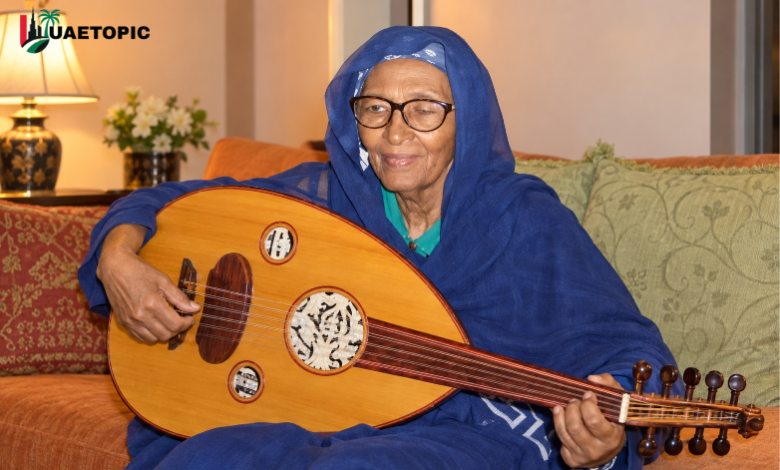
Asma Hamza was a pioneering Sudanese composer and oud player whose contribution to music helped change the position of women in Sudan’s artistic world. She became known for creating melodies, playing the oud, and working with several respected Sudanese singers. Her career was especially remarkable because she entered music during a period when professional composition and instrumental performance were largely dominated by men. Over the years, Asma Hamza created dozens of melodies and became an important figure in the history of Sudanese music.
Interest in her life increased internationally when Google honored her with a special Doodle in July 2023. Many people then wanted to learn more about her age, background, famous songs, musical journey, and achievements. Although some details about her birth year differ between published accounts, her importance as a Sudanese composer is well established. Her story shows how determination, family support, and natural musical talent helped her overcome both personal and social challenges.
Quick Bio of Asma Hamza
| Detail | Information |
|---|---|
| Full Name | Asma Hamza Bashir |
| Arabic Name | أسماء حمزة بشير |
| Profession | Composer and Oud Player |
| Nationality | Sudanese |
| Birthplace | Halfaya al-Muluk, Sudan |
| Birth Year | Reported as 1932 or 1936 |
| Age | Approximately 81–85 years at the time of her death, depending on the reported birth year |
| Date of Death | May 21, 2018 |
| Main Instrument | Oud |
| Known For | Pioneering female composer in Sudanese music |
| First Known Composition | Ya Oyouni |
| Popular Composition | Al-Zaman Al-Tayyib |
| Major Musical Work | Azza wa Izza |
| Musical Output | More than 90 melodies |
| Major Recognition | Laylat Al-Qadr Al-Kubra Music Competition, 1997 |
| Google Doodle Tribute | July 17, 2023 |
| Legacy | One of Sudan’s pioneering female composers and oud musicians |
Who Was Asma Hamza?
Asma Hamza Bashir was a Sudanese composer and talented oud player. She was born in Halfaya al-Muluk, an area in Sudan that became closely connected with her personal and professional life. From an early age, she was interested in music and dreamed of becoming a singer. However, problems with her vocal cords made singing difficult. Instead of giving up her interest in music, she began expressing melodies by whistling and listening carefully to songs around her.
Her father played an important role in encouraging her musical ability. When he noticed that Asma could whistle melodies accurately, he supported her interest and helped her obtain an oud. The oud is a traditional string instrument widely used in Sudanese and Arabic music. Asma quickly developed a strong connection with the instrument. She learned melodies by listening to them and gradually became skilled enough to create her own compositions.
Asma Hamza Age and Early Life
There is some disagreement about Asma Hamza’s exact year of birth. Some published biographies report that she was born in 1932, while other Sudanese and Arabic sources give 1936 as her birth year. Some reports provide the date December 11, 1936. Because reliable sources do not completely agree, it is safer to say that Asma Hamza was born during the 1930s in Sudan.
She died on May 21, 2018, after a long and influential musical career. Depending on which birth year is used, she was either in her early eighties or mid-eighties when she died. The difference in reported dates has caused confusion among readers searching for her age. However, the uncertainty surrounding her exact age does not change the importance of her achievements in Sudanese music or the cultural influence she developed throughout her life.
How Asma Hamza Started Playing the Oud
Asma Hamza’s journey with the oud began when she was still young. Her inability to pursue singing could have ended her dream of building a musical career, but it instead encouraged her to develop another form of artistic expression. Her father recognized her strong ear for music and helped her begin learning the oud. Reports about her life commonly connect the beginning of her serious oud playing with the late 1940s.
Learning the oud allowed Asma to turn melodies she heard in her mind into complete musical pieces. The oud does not have frets like many modern guitars, so playing it accurately requires a strong sense of pitch and careful listening. These qualities suited Asma’s natural musical abilities. She became known for remembering melodies and reproducing them through the instrument, eventually moving from playing existing songs to producing her own original compositions.
Asma Hamza Songs and Famous Compositions
Asma Hamza is often searched for because of her songs, but she was primarily a composer rather than a professional singer. This means many songs connected with her name were written or composed by Asma and then performed by other Sudanese singers. Her first widely mentioned composition was “Ya Oyouni,” which is generally dated to around 1956. The composition was connected with poetry by Egyptian poet Ali Mahmoud Taha.
Another important composition in her career was “Al-Zaman Al-Tayyib.” The song became one of the works that helped bring greater public attention to Asma as a composer. The lyrics were written by Sudanese poet Saif Al-Din Al-Desouki, while singer Sumaya Hassan performed the song. Reports about Asma’s career state that she created more than 90 melodies covering romantic, religious, patriotic, and other musical themes.
Al-Zaman Al-Tayyib and Her Musical Recognition
“Al-Zaman Al-Tayyib” became especially important in Asma Hamza’s professional journey. The song was associated with a period when she was becoming more widely recognized in Sudan’s music community. It was performed in the early 1980s and demonstrated her ability to combine poetry with attractive and emotional melodies. The work helped audiences recognize the person behind the composition rather than focusing only on the singer performing it.
During the same period, Asma became connected with more professional musical institutions. She reportedly began working with the Sudanese Music Corps during the early 1980s. This gave her an opportunity to develop her work in a more formal environment. By that stage, she had already spent many years learning, performing, and composing, meaning her recognition came after a long period of dedication rather than sudden success.
Azza wa Izza and Other Musical Work
Among the larger works associated with Asma Hamza is the musical operetta “Azza wa Izza.” Asma reportedly considered this one of the biggest works she composed during her career. Creating a larger musical production was different from writing a single song because it required greater planning, musical development, and coordination between different sections of the composition.
Asma also worked with several respected Sudanese performers during her career. Artists connected with her compositions include Abdel Karim El Kabli, Mohamed Mirghani, Hisham Darmaas, Sumaya Hassan, and Abida Al Sheikh. Her ability to work with different singers shows the flexibility of her musical style. Her reported catalogue of more than 90 melodies demonstrates that her contribution was much larger than the small number of compositions that are commonly discussed online today.
Asma Hamza and Sudanese Music
Asma Hamza became important not only because of her musical talent but also because she entered an industry where women had limited opportunities. In her early years, it was unusual for Sudanese women to work publicly as instrumental musicians and composers. Some accounts say she kept her earliest compositions private because female participation in professional music was not widely accepted.
Her father’s encouragement was therefore especially valuable. With his support, she was able to continue learning and eventually build a career in a male-dominated environment. Asma is frequently described as one of Sudan’s earliest female composers and pioneering female oud players. Some sources have called her the first female composer in Sudan, while broader claims that she was the first in the entire Arab world are more difficult to establish with certainty.
Musical Influences and Love for Umm Kulthum
Asma Hamza was influenced by famous musicians from across the Arabic-speaking world. Egyptian music was especially important to her artistic development. She admired legendary singer Umm Kulthum and was also influenced by major artists such as Mohammed Abdel Wahab, Abdel Halim Hafez, and Shadia. These musicians were among the most important figures in twentieth-century Arabic music.
Her admiration for Umm Kulthum was particularly strong. During a visit to Egypt, Asma reportedly had the opportunity to attend one of Umm Kulthum’s performances. The influence of wider Arabic musical traditions helped Asma develop her own style while remaining connected to Sudanese musical identity. The oud became the instrument through which she combined these different influences and expressed her own approach to melody.
Awards, Google Doodle and Later Recognition
One of the major moments in Asma Hamza’s later career occurred in 1997 when she became one of the winners of Sudan’s Laylat Al-Qadr Al-Kubra music competition. The achievement gave her greater recognition and became an important date in her professional history. Winning recognition in a field traditionally dominated by men also made the achievement significant for the history of Sudanese women in music.
On July 17, 2023, Google celebrated Asma Hamza with a special Doodle marking the anniversary of this achievement. The illustration showed her with an oud and introduced her story to a much wider international audience. The tribute appeared in several countries across the Middle East and North Africa and created renewed interest in her biography, songs, musical career, and contribution to Sudanese culture.
Conclusion
Asma Hamza was one of the pioneering figures of Sudanese music. Her journey started with a childhood dream of becoming a singer, but problems with her voice led her toward the oud and composition. What initially appeared to be a limitation eventually helped shape her unique musical career. With support from her father, she developed her talent, created original melodies, and worked with some of Sudan’s respected singers.
Her compositions, including “Ya Oyouni,” “Al-Zaman Al-Tayyib,” and the larger “Azza wa Izza” project, remain important parts of her musical story. More than 90 melodies are associated with her career, demonstrating the scale of her contribution. Although uncertainty remains about whether she was born in 1932 or 1936, her cultural importance is clear. Asma Hamza died in 2018, but the 2023 Google Doodle introduced her achievements to a new generation and helped preserve the memory of a Sudanese woman who helped open new possibilities for female composers and instrumental musicians.
